
Chongqing, July. The afternoon temperature is pushing 40 °C. At a high-rise fire, the interior attack team has already entered the stairwell. From outside, the incident commander issues an order over the radio: heavy smoke on the third-floor landing, take the east corridor instead. What reaches the crew is a hum.
This is not an equipment failure. It is what fire rescue communication is actually up against. The firefighters are wearing helmets and sealed SCBA masks. Around them: positive-pressure fans, structural collapse, the exhaust of their own regulators. Ambient noise routinely exceeds 100 dB. A conventional radio speaker with a handheld microphone simply stops working here. Their hands are on the branch. The mask blocks the mouth's acoustic path. And a headset that seals the ear cuts off the situational hearing they depend on. A firefighter who cannot hear the collapse warning behind them is in a different kind of danger.
When the link breaks, the cost is never just "we didn't hear that."
At a handover training session in Qujing, Yunnan, a crew leader with seventeen years on the job made a very plain request: "I don't need features. I need to be answered when I call, to hear clearly, and to take it off fast."
That is the point we keep returning to. Bone conduction delivers sound as vibration directly through the skull, bypassing the eardrum and leaving both ears open (see the PTE-570EX MASKCOM). Crews hear the order and still hear direction, distance and change around them. Situational awareness should not be the price of clear audio.
From that principle we built three headset families, each matched to a different wearing condition.
The SCBA facepiece is the firefighter's most critical piece of breathing equipment, and the hardest to add audio to. Break the seal and positive pressure is lost; the protection the whole system exists for is gone.
Our SCBA headset, the PTE-570EX MASKCOM, solves this structurally. A single-sided bone-conduction pad sits against the facepiece and the temple without intruding on the sealing zone. A dedicated quick-release connector lets the wearer detach one-handed in an emergency, without removing the mask and without help from a teammate. The connector is a TP-120 / U174 / U93 pattern with a 7.1 mm plug, fitting major SCBA brands and a wide range of PTT adapters, so replacing equipment batches does not mean reconfiguring the entire audio system.
The headset carries CN ATEX Ex ia IIC T6 Ga explosion-proof certification and an IP68 water-proof rating. Water cannon streams, foam coverage and wading search are routine, and IP68 means it keeps working while submerged. Ex ia intrinsic safety means the unit cannot itself become an ignition source in a flammable atmosphere. In a chemical warehouse or at a gas leak, that matters more than any audio figure. Cable and PTT are both fire-resistant.
During a hazardous-materials warehouse exercise in Chongqing, one crew member went from donning to live comms in under twenty seconds. Three position adjustments issued by the commander from 200 metres out over a repeater all came back correctly.
 |
 |
 |
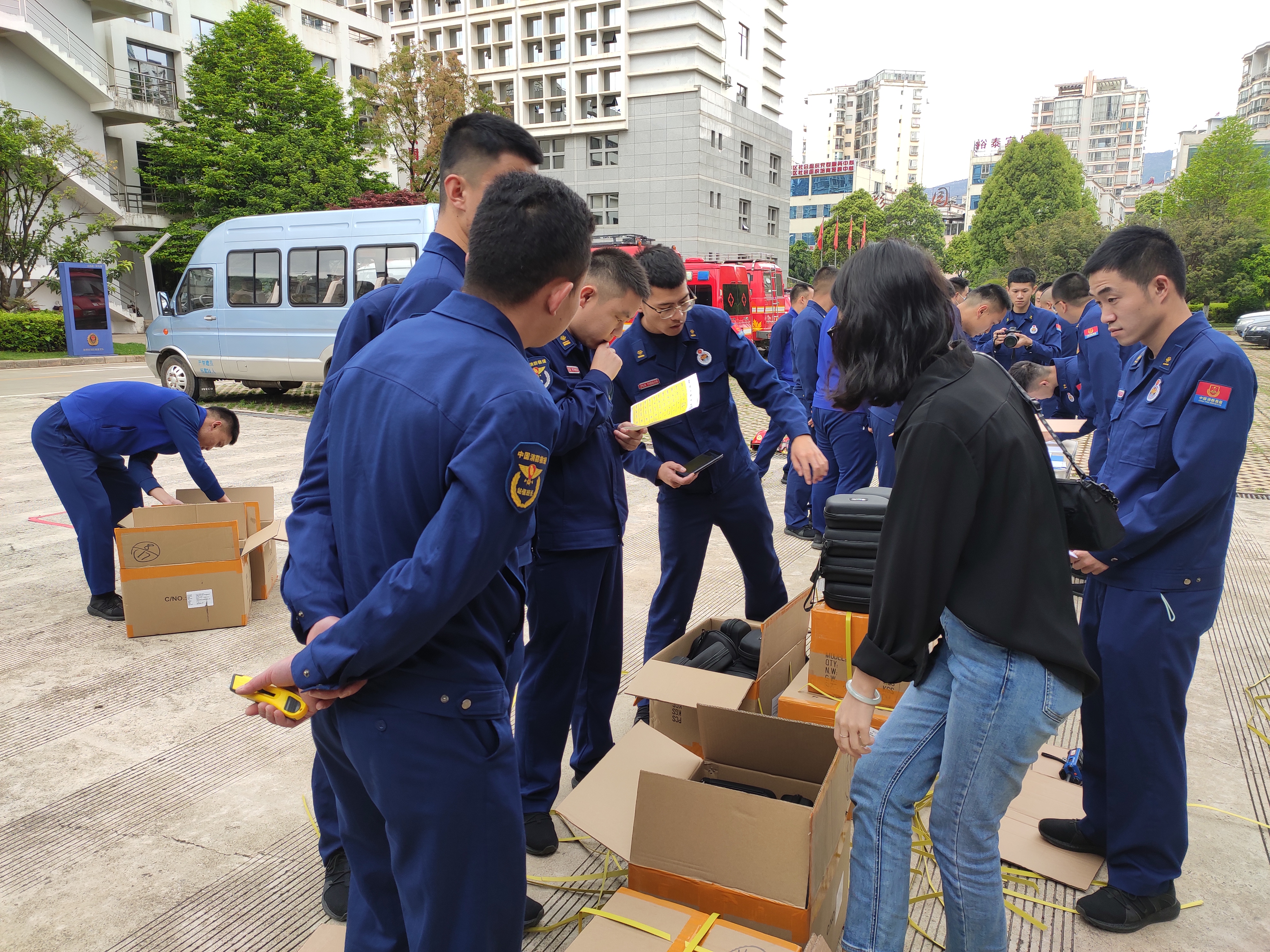
Caption: Chongqing handover and training session for the PTE-570EX MASKCOM. Crews completed radio pairing while under full SCBA.
On the Qujing project in Yunnan, the same headset went through an entire live-training cycle with the brigade. The two frames below are from that handover.
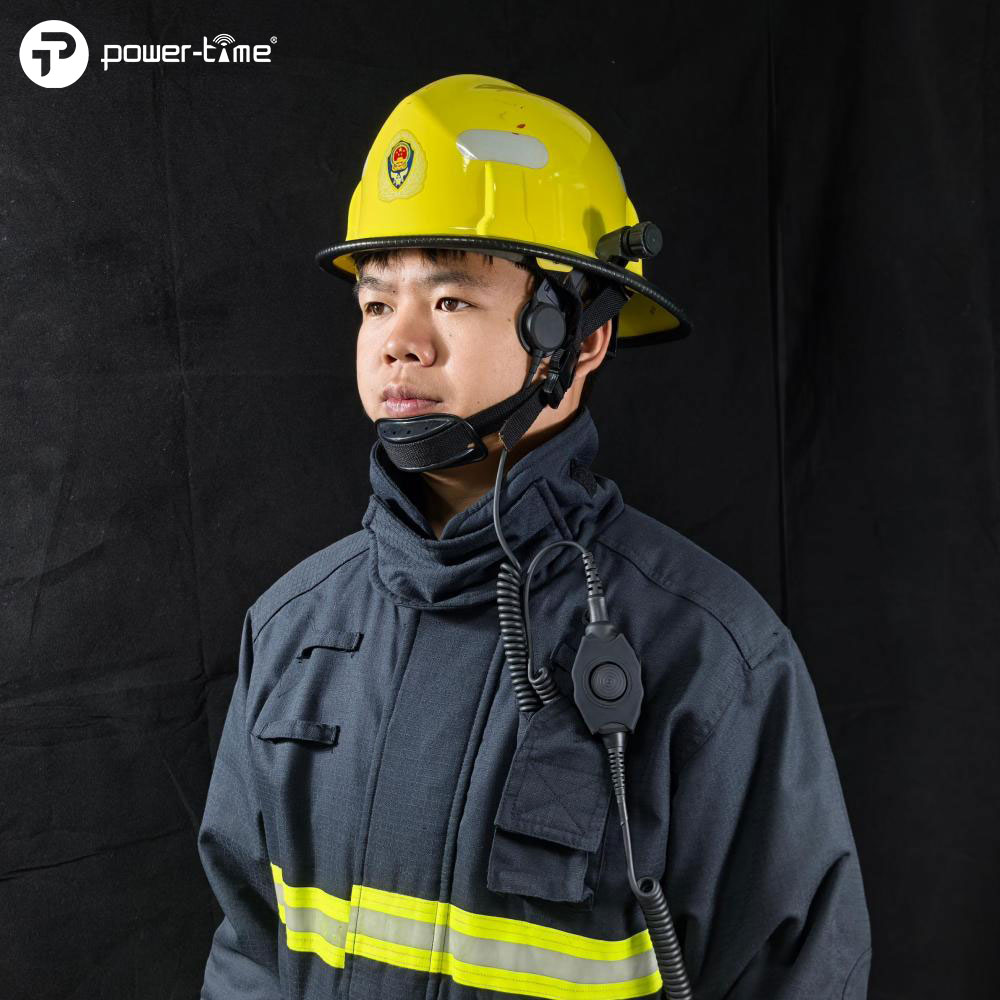
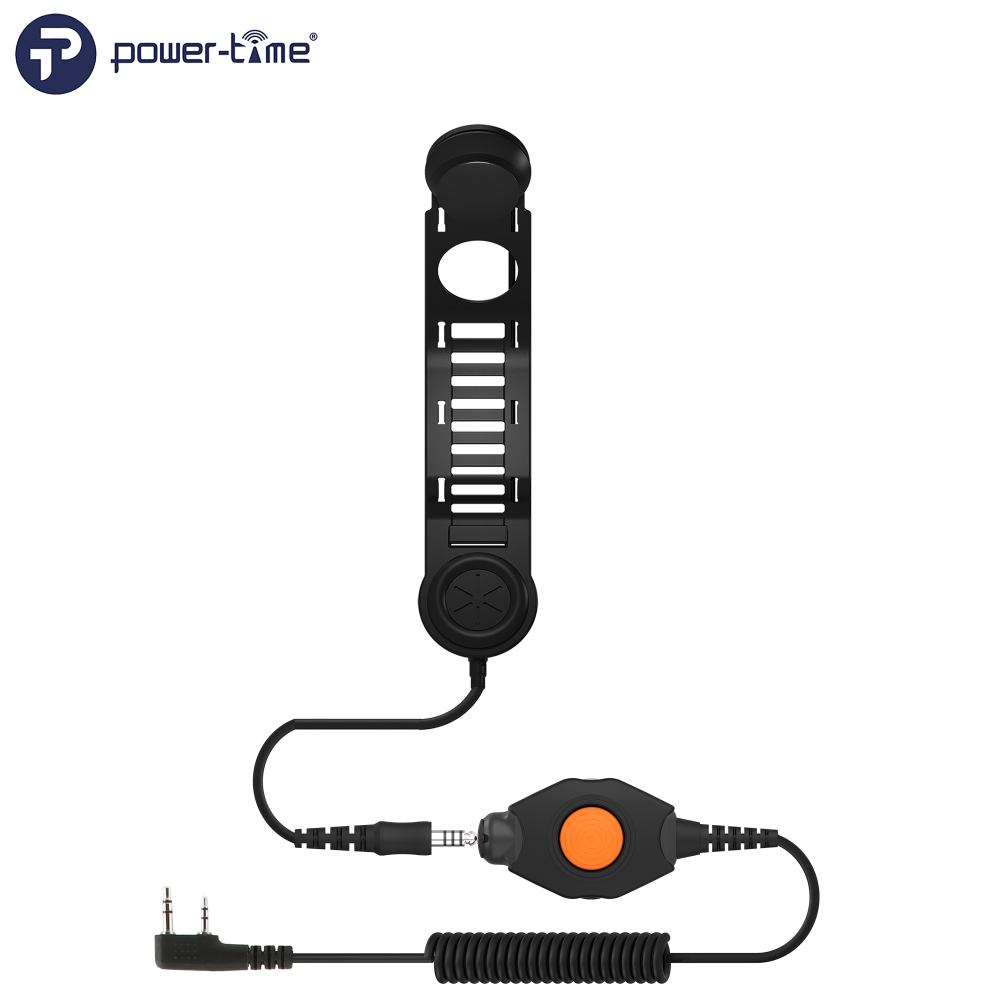
Fire helmet models vary widely between brigades, and safety helmets span entire industries. The PTE-129F uses a shoulder-strap mounting design that fits inside 99% of helmets in service, with options for different band, chinstrap and shell positions.
The procurement consequence is practical: no brigade has to replace its helmets to get audio. The same headset can be issued to interior attack crews, drivers and perimeter security at once, which means one spare-parts line, one training standard, one inventory.
The engineering sits where you do not see it. The cable is environmental-grade PU reinforced with Kevlar, so it survives being yanked, snagged and crushed — on a fireground, the failure that actually happens is a torn cable, not a dead circuit. The IP67 quick-release PTT uses a large button that a gloved hand can hit first time. Certification is CN Ex ib IIC T6 Gb, again intrinsic safety, for firefighting, rescue, mining and chemical work.
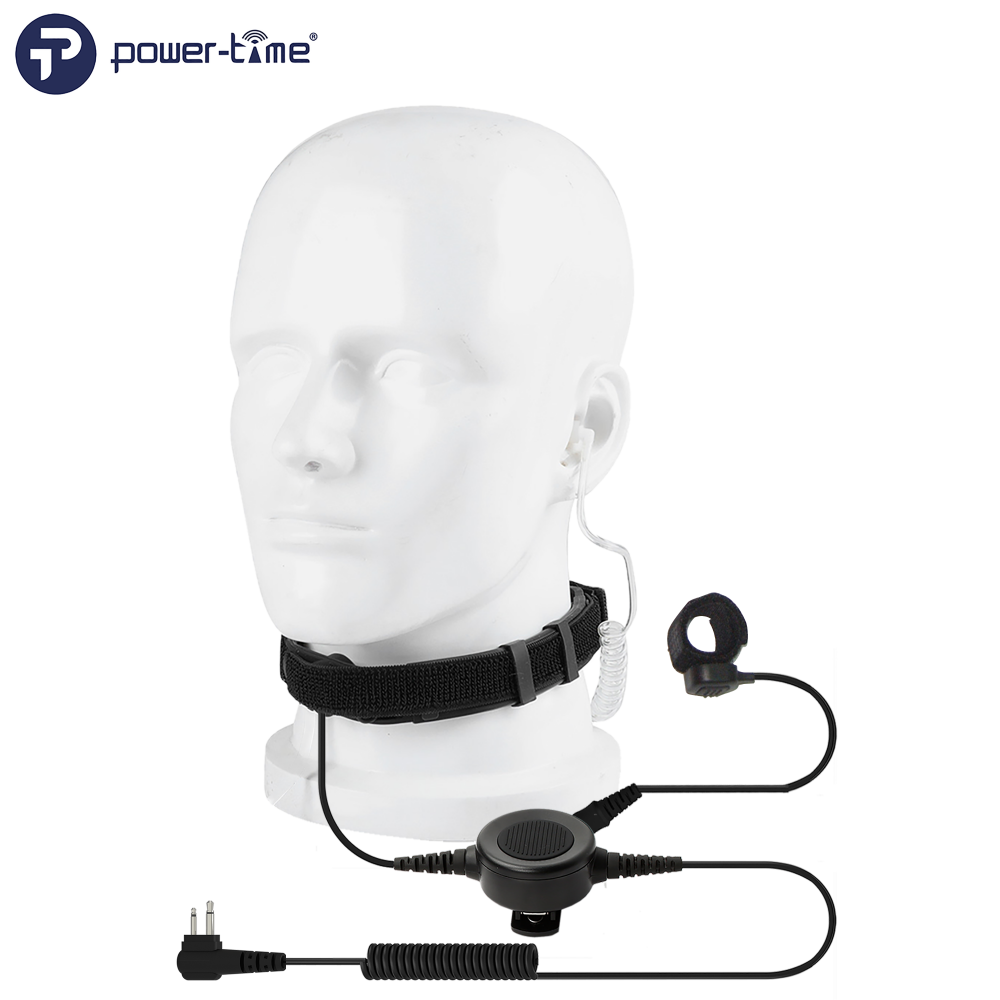
Chemical response, decontamination, mining and tunnel rescue: crews are inside fully encapsulated suits. The mask does not pass sound, the helmet cannot carry external mounts, and a conventional microphone picks up nothing but fabric friction.
The PTE-796S takes sound through an acoustic tube and uses a bone-conduction microphone that reads vocal-cord vibration at the throat rather than airborne sound. Suit friction, crosswind from fans, exhaust from the breathing valve — all of it is physically excluded, and the result does not depend on the surrounding acoustic field at all, which is exactly what a sealed suit requires.
The details are targeted. The tube uses hypo-allergenic material for long wear against the skin. A Nexus quick-disconnect and IP67 protection pair with a 3.5 mm jack. The PTT comes in two forms — a large round button or a finger-style remote that sits on the finger, so a long mission does not require reaching for a button. It fits protective masks and tactical helmets, covering hazmat, decontamination, and SWAT or military use.
All three headsets use flame-retardant materials for housings and cabling; the PTE-570EX uses VW-1 rated fire-resistant cable. Every component of firefighting equipment may operate in heat, sparks and radiant flux. A headset is no exception. This is not a feature for a later revision; it is written into the bill of materials from day one.
What says more than the material spec is the numbers: IP68 / IP67 water-proof, and Ex ia IIC T6 Ga / Ex ib IIC T6 Gb intrinsic safety. The first answers "does it still work after being submerged." The second answers "can it start a fire in a flammable atmosphere." At a chemical park, a fuel terminal or a utility tunnel, equipment without both does not get onto the site.
All three also support multi-radio adaptation. Radio brands, models and connector pinouts differ enormously between units. We supply the matching interface modules and wiring schemes, and pairing and commissioning are completed on site without replacing the existing radio system.
| PTE-570EX MASKCOM | PTE-129F | PTE-796S | |
|---|---|---|---|
| Design | Single-sided bone conduction, worn with facepiece | Skull bone conduction, shoulder-strap mount | Throat acoustic tube + bone-conduction mic |
| Fits | SCBA masks of major brands, wide range of PTT adapters | 99% of fire helmets and safety helmets | Encapsulated suits, protective masks, tactical helmets |
| Connector | TP-120 / U174 / U93, 7.1 mm | Quick-release PTT, large button | Nexus quick-disconnect, 3.5 mm jack |
| Ingress | IP68 | IP67 (PTT) | IP67 |
| Ex rating | CN ATEX Ex ia IIC T6 Ga | CN Ex ib IIC T6 Gb | — |
| Cable | Fire-resistant (VW-1) | Environmental PU + Kevlar | Flame-retardant |
| Typical user | Interior attack, SCBA crews | All firefighting and helmeted work | Hazmat, decon, SWAT and military |
On the Yunnan and Chongqing projects we did more than ship boxes. Site survey, helmet and mask matching, radio frequency planning, batch pairing, crew-by-crew training, spares and maintenance schedules — the whole sequence travels with the equipment. Supporting documentation is available on our certificates page, and an overview of our production facilities is on the manufacturing capabilities page.
A captain in Chongqing wrote one line on the acceptance form: "Wearing a headset used to be a burden. Now it's a habit." We copied it out and taped it to the sample cabinet.
We build bone-conduction communication equipment for firefighting and emergency response, covering the three typical conditions — SCBA, helmet-mounted and fully encapsulated suits — each certified for intrinsic safety and high-grade water ingress protection, with deliveries and training completed across multiple provinces and municipalities in China.
Product details and selection advice:
| PTE-570EX MASKCOM SCBA bone-conduction headset · Ex ia IIC T6 Ga · IP68 |
View product → |
| PTE-129F Skull bone-conduction headset · fits 99% of helmets |
View product → |
| PTE-796S Throat microphone · dual PTT · IP67 |
View product → |
If you are selecting communication equipment for your brigade, contact us and we will bring samples to your station and let your crew put them on. Hearing it clearly beats reading any spec sheet.
Why do firefighters use bone conduction or acoustic tube earpieces instead of regular speakers?
In fire scenes, ambient noise from pumps, sirens and collapsing structures can exceed 100 dB. In-ear speakers cannot overcome this safely, while bone conduction leaves the ear canal open for situational awareness and acoustic tube designs isolate speech from background noise, keeping every order intelligible.
Are these earpieces compatible with intrinsically safe radio requirements?
Yes. Selected models carry CN ATEX certification and are designed to pair with intrinsically safe radio configurations used by fire and emergency services. Always confirm the certification level of the complete radio-earpiece combination with our team before deployment.
Can the earpieces withstand water, heat and rough handling?
Yes. The fire rescue line uses industrial-grade cables and components with high water and sweat resistance, built for turnout gear, gloves and high-temperature environments. Cable reinforcement and strain relief are engineered for repeated emergency deployment.
Which radio brands and models do you support?
We manufacture compatible earpieces for major radio brands including Motorola, Kenwood, ICOM and Hytera, covering popular fire-service models. Send us your radio model and we will confirm the matching connector and accessories before you order.
